Why Your AI Pilot Went Nowhere
The tool worked. The pilot still died. The three absences that kill AI initiatives, and what the leaders who break the pattern do differently.
By Michael Steve · July 15, 2026 · 4 min read
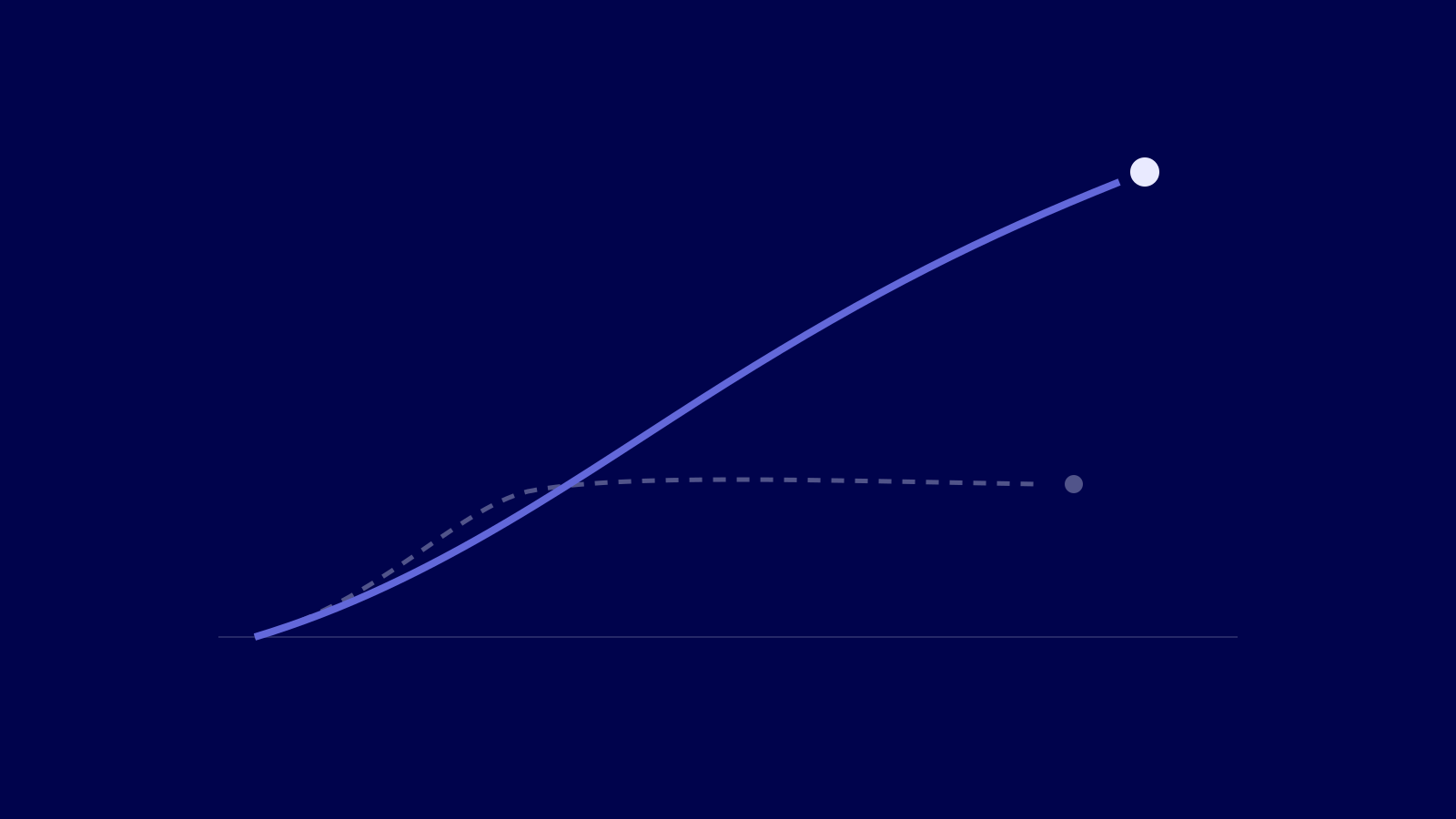
Somewhere in your organization there is a dead AI pilot. It launched with an enthusiastic email eight or fourteen months ago. There was a tool, a working group, maybe a lunch demo that genuinely impressed people. For a few weeks, activity. Then the sponsor got busy, the novelty wore off, the working group's meetings got shorter and then optional, and today the subscription either quietly renews unused or someone finally cancelled it.
If it is any comfort, this is the standard outcome, in every industry, at every size. But the standard explanation is wrong, and the wrongness matters. The post-mortem always blames the tool, the timing, or the team's readiness. Look closely at your own dead pilot and you will find the tool mostly worked, the timing was fine, and the team was willing. What was missing was never technical. It was three specific absences of leadership, and each one is correctable.
Absence one: nobody owned it
Not "nobody was assigned." Someone was always assigned: a working group, an innovation lead, a volunteer enthusiast. But assignment is not ownership. Ownership means a specific person whose own standing rises or falls with the outcome, who has the authority to change how work is actually done, and who wants the ground.
Pilots get assigned to people as an addition to their real job. The moment their real job pressed, and it always presses, the pilot became the thing that could slip without consequence. What survives in organizations is what someone claims, not what someone staffs. A pilot with a committee has diffusion; a pilot with an owner has a heartbeat. If you cannot name the single person for whom this initiative was territory, in the claimed, personal sense of the word, you have found cause of death number one.
Absence two: it solved nothing anyone was bleeding from
Recall how the pilot was chosen. Almost always, it started from the tool: here is an impressive capability, where could we use it? That question feels strategic and is actually backwards, because it selects for what is demonstrable rather than what is valuable.
Value hides in friction: the delays everyone plans around, the manual work nobody trusts but everyone repeats, the recurring cost so normalized that people answer questions about it with "that's just how it works." A pilot aimed at real friction has customers on day one, because somebody is bleeding from that problem every week and will drag the solution into their workflow. A pilot aimed at a capability has an audience, and audiences applaud and leave.
The test is retrospective and unsparing: when your pilot stalled, who was harmed? If the answer is nobody in particular, the pilot never had a reason to exist beyond its own announcement. The organizations that break the pattern pick the problem first, from where the friction actually costs money or hours, and let the problem select the tool.
Absence three: no standard, so no trust
The quietest killer. For AI output to enter real workflows, the people using it need to know what good looks like, what gets verified, and who answers if it is wrong. Most pilots launch with none of that: no definition of acceptable output, no verification habit, no named accountability. The result is predictable in both directions. Some team members trust the output too much, and the first visible error poisons the well. Others never trust it at all, doing every task twice, and correctly conclude the pilot made their week longer.
Adoption is not an enthusiasm problem. It is a trust problem, and trust is built from standards. Ungoverned AI use does not stay at zero; it just goes informal, which is the worst of both worlds: your organization gets the risk of AI adoption and none of the compounding benefit, while the official pilot starves.
Pilots do not die of bad technology. They die of no owner, no wound, and no standard, and all three were visible at launch.
The pattern the successful ones share
Flip the three absences and you have the anatomy of the AI initiatives that actually compound, and notice how unglamorous it is. One named owner who wants the ground. One real friction point that costs someone hours or money every week. One written standard for what good output is, what gets checked, and who answers. Then, only then, a tool, chosen because it fits the problem, and given long enough to become a habit rather than an event.
That shape is deliberately small. It does not demo well at a leadership offsite. It also does not die, because every element has a reason to exist independent of enthusiasm, and enthusiasm is the only fuel a launch email provides.
The part that is about you
One more honest layer. Dead pilots are usually described as organizational failures, but the three absences trace back to a single upstream one: the leader who sponsored the pilot had not yet done their own work. Not the tool evaluation, the position work: a personal, owned clarity about what AI actually is, where it belongs in this specific organization, and which ground is worth claiming with it. Sponsors without a position launch capabilities. Leaders with one solve frictions, because the position tells them which frictions are theirs.
That position is buildable in a week; it is what the AI Stakeholder Challenge produces by design: clarity built rather than borrowed, a real delegation discipline, and a declared territory with an owner, you, before any tool gets chosen. Your next pilot does not need a better vendor. It needs the three absences filled before launch, starting with the one in the sponsor's chair. Fill them, relaunch small, and let the dead pilot's subscription finally rest in peace.
Michael Steve
Founder of the AI Stakeholder Challenge. Helping leaders move from AI awareness to AI leadership.