Reactive Leadership Is a Margin Problem, Not a Flaw
Constant firefighting is not a personality type. It is what happens when judgment margins collapse, and margins can be rebuilt deliberately.
By Michael Steve · August 3, 2026 · 5 min read

You know the week. It starts with a plan and ends with a blur: the loudest issue won every day, decisions got made at the speed of the inbox, the strategic thing slid to Friday and then to never, and you went home each evening having worked flat out on nothing you chose. Then the private conclusion arrives, the one almost every manager reaches eventually: maybe I am just not disciplined enough. Maybe I am a firefighter by nature.
That conclusion is wrong, and it is worth being precise about why, because the wrong diagnosis leads to the wrong cures: the time-management book, the earlier alarm, the guilt. Reactive leadership is not a personality type and not a character flaw. It is what happens, mechanically, to any leader whose judgment margins have collapsed. And margins, unlike personalities, can be rebuilt.
The mechanism: judgment runs out before the day does
Two kinds of demands compete for a leader's day. Judgment work requires discernment: real trade-offs, real consequences, calls that improve with your experience and deplete you to make. Attention work merely requires focus: reading, sorting, checking, compiling, re-explaining, the reviewing of things others could have reviewed. The two feel similar in the moment. They are not. Judgment is finite and expensive; attention work is infinite and expands to consume whatever it is given.
Here is the mechanism nobody explains to new managers: when attention work fills the day, judgment does not get saved for the moments that need it. It gets pre-spent. By the time the genuinely consequential question arrives at 3pm, the discernment it deserves was already burned on an inbox, two status meetings, and being the final pass on work that never needed you. So the big call gets made reactively, tired, at the speed of everything else. Not because you lack judgment. Because it was gone.
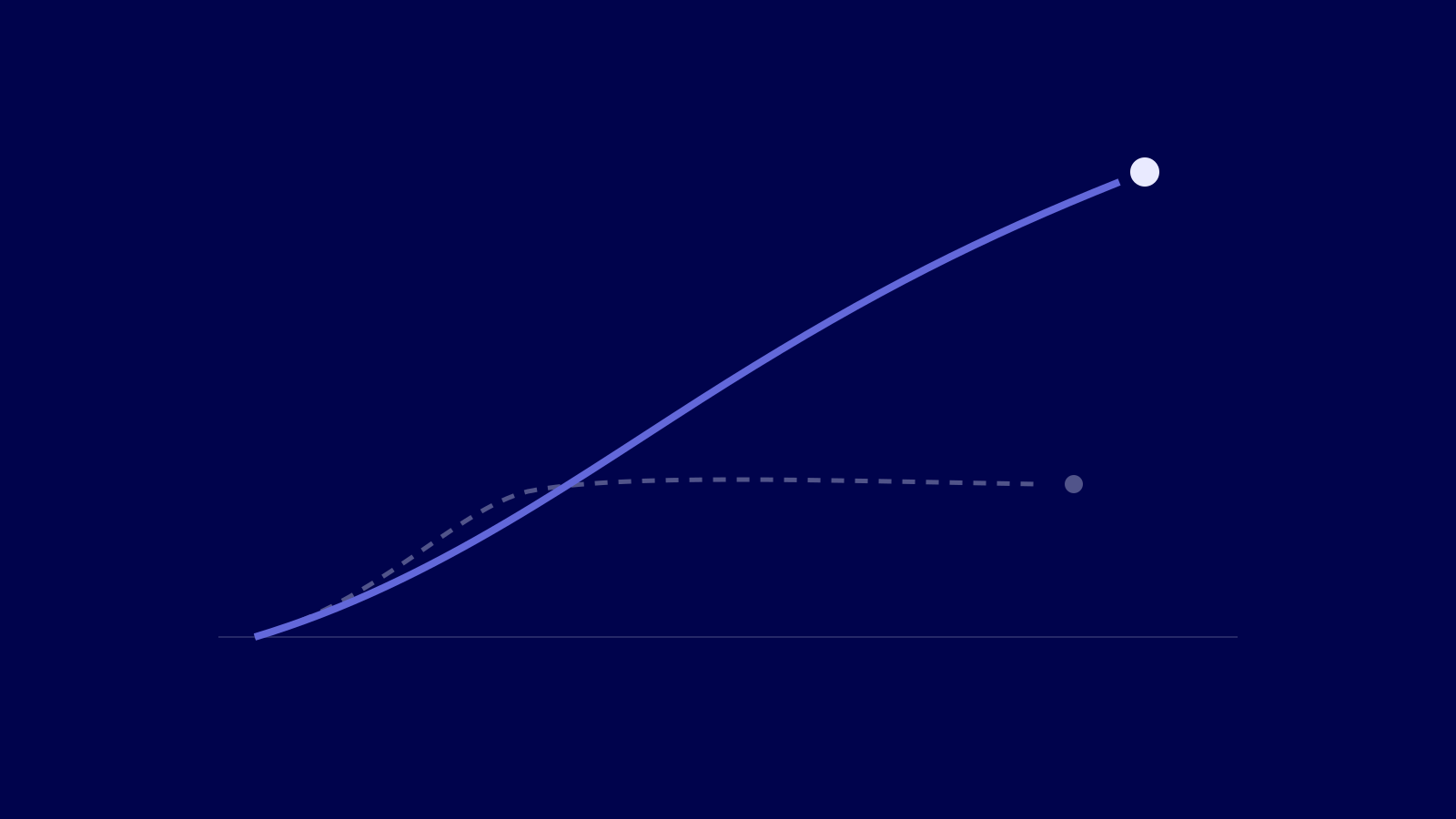
Run that loop for a quarter and it becomes self-sustaining: rushed decisions create rework, rework creates fires, fires consume more margin, and the leader becomes "reactive" the way a flooded engine becomes slow. The flaw was never in the driver.
Reactive leadership is not a personality. It is what any leader becomes when their judgment is spent before their decisions arrive.
Why this got worse, and what just changed
Middle leadership has always been squeezed, but the modern version is sharper: accountable upward for results, responsible downward for direction, and positioned exactly where the organization's attention work concentrates: the reports, the approvals, the escalations, the being-cc'd-on-everything. The squeeze is structural, which is why the personal-discipline cures keep failing; you cannot alarm-clock your way out of a position that manufactures attention work faster than you can process it.
What changed is that, for the first time, the attention layer is delegable without headcount. The patterned share of a manager's week, the compiling, the summarizing, the drafting, the same-question-answered-again, is precisely what AI absorbs under direction, and direction here means something ordinary: briefing it the way you would brief a capable new hire. Not the judgment: no tool makes your trade-offs, owns your consequences, or has the conversation your struggling report needs. The technology's honest offer to a squeezed manager is narrower and better: it will carry the attention work, so your judgment arrives at 3pm intact.
The discipline for taking that offer has two halves: an honest sort of your week into what only you can do and what merely lands on you, and standards, because delegating attention work without verification habits just converts your margin problem into a governance one.
Rebuilding the margin: three moves this month
Reclaim, deliberately. Run the margin audit across last week, one question per task: if a capable person had clear instructions, could they do 80% of this? Everything that passes is a delegation candidate, to AI or to a person, and most managers find double-digit weekly hours in the pile. Take back three of them this month, not twenty; the point is establishing that the direction is reversible.
Protect, structurally. Margin that is not scheduled gets eaten. Put the judgment work, the thinking, the real decisions, the difficult conversation you have been deferring, on the calendar as immovable blocks, and treat the false urgency test with respect: if delaying something a day would not materially change the outcome, it is attention work wearing a costume, and it does not get to interrupt.
Push the discipline downward. Your team inherits your margins. A reactive manager produces a reactive team, because escalations get answered at the speed of panic and everyone learns that loud beats important. When you rebuild your own margin, narrate it: here is what I stopped doing, here is the standard for what interrupts me now, here is the same audit for your own week. Expect the narration to raise the question underneath it, which is what all of this means for their jobs, and be ready to answer that honestly rather than deflect it. A team that protects its collective judgment is the multiplier version of everything in this briefing.
The second move is where most attempts die, and the reason sits above you. A leader in the middle does not fully own their calendar, and a block nobody negotiated gets overwritten by the first escalation from someone senior. So make the trade visible rather than silent. Tell the person you report to which hours are protected and what those hours are producing. Framed as availability, it sounds like a boundary and gets overruled. Framed as output, the strategic review they have been waiting three weeks for, it tends to get defended by the same person who would otherwise have interrupted it.
The identity shift at the end of it
Somewhere a few weeks in, a strange thing happens to leaders who do this: the identity dissolves. The "firefighter," the "not a strategic thinker," the "just not disciplined": these turn out to have been descriptions of a margin condition, not a person. Decisions start being chosen instead of triggered. The strategic work stops sliding to Friday. And the leader discovers what was true the entire time: the judgment was always there. It was just never available.
That availability is the quiet foundation under everything else a leader might want to do in an AI-shaped decade, because every larger move, the claimed ground, the team capability, the authority upward, runs on judgment that has room to breathe. Rebuilding it is Day 1 and Day 2 work in the AI Stakeholder Challenge: the delegation sort, the margin audit with a real number on it, and the fluency to make the delegation actually hold. But the diagnosis is available today, free, in one honest look at last week's calendar. You were never the fire. You were standing in one, and there is a door.
Michael Steve
Founder of the AI Stakeholder Challenge. Helping leaders move from AI awareness to AI leadership.